
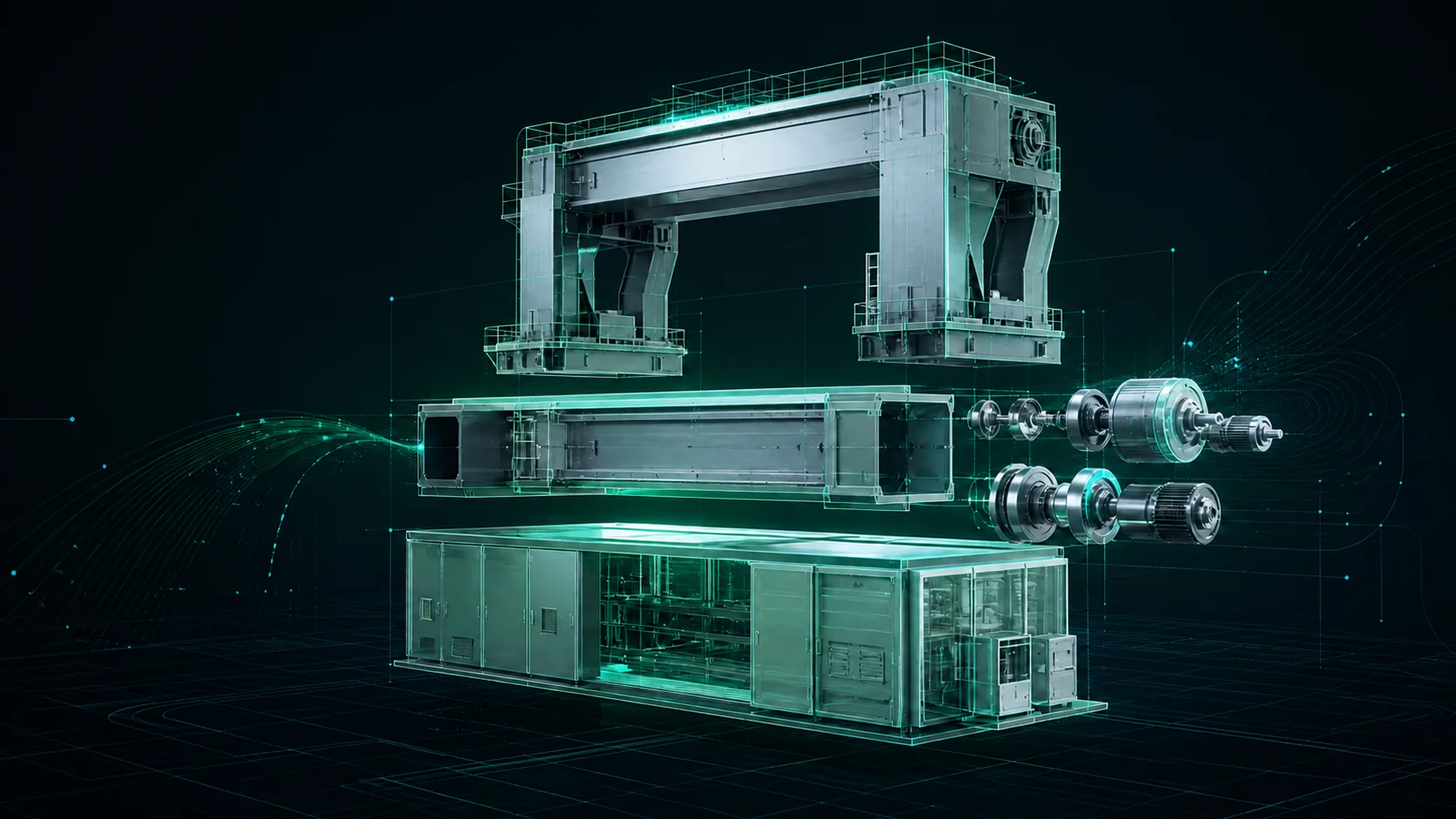
Scope
Key port-machinery components combine recurring structural patterns with project-specific dimensions, openings, interfaces and configurations. A model family should distinguish reusable elements from those requiring individual design, rather than force every structure into one complex template.
This page develops the existing website overview of rear girders, rail-mounted gantry frames, high-voltage rooms, electrical rooms, ladders and platforms. It does not disclose customer drawings or proprietary project dimensions.
Build component families
Group components by topology, connection method and manufacturing process. Define driving parameters, derived parameters and specification tables for each family. Use separate templates for substantial topology changes and parameter- or configuration-driven models for stable dimensional variations.
Keep interfaces and files consistent
Treat mounting faces, hole positions, datums and connection dimensions as explicit interface constraints. When generating a variant, check adjacent components, assembly references, material properties and naming rules. A valid part must also fit its intended assembly.
Validate and maintain
Verify common sizes, dimensional limits, mirrored arrangements and optional configurations, including drawings and bills of materials. Re-run representative examples after template changes and record versions and incompatible changes. Deliverables may include a template library, specification inputs, generation tools and verification records; each structure still requires the appropriate engineering review.